Showing posts with label Obama. Show all posts

Wednesday, March 14, 2018

POMPEO COMO SECRETARIO DE ESTADO, OTRA MALA NOTICIA PARA RUSIA

Mike Pompeo, un halcón para dirigir las relaciones exteriores de EE UU

El hasta ahora director de la CIA procede del movimiento ultraconservador Tea Party, es duro contra Irán y ha sabido ganarse a Donald Trump

AMANDA MARS, PARA EL DIARIO EL PAIS, ESPAÑA, 14 DE MARZO DE 2018

Halcón, político de carrera y en la cuerda de Donald Trump. El presidente ha optado por relevar al moderado Rex Tillerson, un ejecutivo petrolero con quien nunca congenió, por el perfil antitético de Mike Pompeo, el hombre al que le confió la CIA hace poco más de un año, un congresista de Kansas miembro del Tea Party, que ha clamado contra el pacto nuclear de Irán, defendido la aplicación de la pena de muerte contra Edward Snowden y destacado como azote de la demócrata Hillary Clinton.
Pompeo, de 54 años, se graduó primero de su clase en la academia militar de West Point en 1986, sirvió varios años en el Ejército (sin entrar en combate) y llegó a patrullar como oficial de caballería en el telón de acero antes de la caída del muro de Berlín. Después se licenció en Derecho en Harvard y comenzó su carrera como congresista por Kansas en 2011, aupado por la ola ultraconservadora del Tea Party. Durante estos años, hasta que el recién elegido Donald Trump lo llamó para hacerse cargo de la CIA, ha formado parte de los comités de Inteligencia, Comercio y Energía de la Cámara de Representantes.
Le dio fama en Washington la dureza con la que fustigó a Clinton en la comisión especial para investigar el atentado de Bengasi (Libia) de 2012, cuando la excandidata presidencial era secretaria de Estado. La investigación acabó sin hallar responsabilidades en Clinton, pero Pompeo llegó a calificar el caso como algo “peor que el Watergate en algunos aspectos”. También se significó en la defensa de la vigilancia masiva ciudadanos y hogares estadounidenses en pos de la seguridad y, en el pasado, llegó a defender la práctica del waterboarding (ahogamientos), argumento que era ilegal, pero no un acto de tortura. Sin embargo, en el Capitolio, antes de que le ratificaran como director de la CIA respondió que no usaría la tortura aunque el presidente se lo pidiera.
Su nombre había sonado como sucesor de Tillerson durante meses, ya que durante ese tiempo el futuro del ex presidente de Exxon Mobil se había estado tambaleando. Fuentes anónimas de la Administración citadas por la prensa estadounidense han destacado la química surgida entre Pompeo y Trump durante las periódicas reuniones informativas de inteligencia. En ellas y en público, el jefe de la CIA ha sabido manejar con mano izquierda uno de los pocos puntos en los que difiere del presidente: la injerencia rusa en las elecciones presidenciales, que el mandatario neoyorquino siempre ha negado o minimizado y que Pompeo nunca ha evitado señalar con dureza.
Su breve mandato como jefe de la inteligencia se ha caracterizado por un perfil muy político en sus pronunciamientos públicos, lo que ha incomodado en muchas ocasiones al personal de la agencia, dado que crea recelos en torno a la imparcialidad que se le exige a los análisis de inteligencia. También ha apostado por una actitud más agresiva en el conflicto de Afganistán, donde se han reforzado las acciones encubiertas son los talibán como objetivo.
Sin experiencia previa en este campo, Pompeo se convierte en jefe de la diplomacia estadounidense en un momento delicado, cuando Estados Unidos está dispuesto a abrir una negociación con Corea de Norte —bajo promesa de desnuclearización por parte del régimen y al mismo tiempo debe decidir si mantiene o abandona el acuerdo nuclear con Irán. En ambos terrenos, el nuevo secretario de Estado se ha mostrado en la línea dura republicana. Y en consonancia con Trump. Por ejemplo, se mostró partidario públicamente al cambio de liderazgo en Corea del Norte y, en el caso de Irán, cuando Obama firmó el acuerdo nuclear, declaró que no veía el momento para cancelarlo. Ahora, habría llegado el momento de esto último, pero los caminos de la realpolitik y de Trump son misteriosos.

Sunday, September 17, 2017

MERKEL, TRAS LOS RECORDS DE ADENAUER Y KOHL


Indispensable Angela

Merkel enfrenta su cuarto mandato desde una centralidad que empezó siendo alemana y ahora es ya europea y global

LLUIS BASSETS, DIARIO EL PAIS, MADRID, SABADO 16 DE SETIEMBRE DE 2017.


Así como hay una superpotencia indispensable, Estados Unidos, según la ex secretaria de Estado Madaleine Albright, también hay un personaje político europeo indispensable, según el semanario The Economist, y este es Angela Merkel. Si no fuera por la obsesión alemana por la discreción y por su reticencia al protagonismo, Merkel sería reconocida como la líder del mundo libre, especialmente desde que Obama dejó la Casa Blanca y le sustituyó el presidente más atrabiliario, errático e irresponsable que haya encabezado el Gobierno de Washington.

El próximo domingo los alemanes tendrán la oportunidad de darle por cuarta vez una mayoría parlamentaria, algo prácticamente asegurado a la vista de las encuestas, en las que las listas socialdemócratas, con su candidato Martin Schulz a la cabeza, se hallan a una distancia inalcanzable —entre 15 y 17 puntos por detrás— para aspirar a algo más que entrar como socios minoritarios en un gobierno de gran coalición. La única incógnita que dilucidarán los electores será la fórmula de gobierno, en función de la composición del Parlamento, pero no la centralidad de la coalición conservadora CDU-CSU y de la figura indispensable de Merkel.
La tonalidad del cuarto mandato de Merkel en la cancillería dependerá de los socios que se vea obligada a escoger entre las tres opciones posibles en un mapa parlamentario en el que no se dan mayorías de gobierno en solitario. La opción más clara son los liberales del FDP, el socio habitual de la CDU-CSU en la coalición burguesa durante los años de la Alemania de Bonn, con los que también Merkel hizo gobierno en su segundo mandato entre 2009 y 2013. Para que esta fórmula sea posible los liberales deben salir del bache en el que se metieron hace cuatro años, cuando se quedaron sin representación parlamentaria por primera vez desde la fundación de la actual república.
Siempre está a mano la gran coalición, la fórmula que mejor refleja el consenso central de la política alemana, que lleva a gobernar juntos a los dos partidos concebidos para actuar como adversarios, uno en el Gobierno y el otro en la oposición, con el inconveniente de que dan cancha política a quienes serán los extremos, la izquierda radical Die Linke y el partido anti inmigración AfD (Alternative für Deustchland).
Hay todavía una tercera fórmula inédita, en la que una insuficiente mayoría parlamentaria conservadora-liberal se vería completada por los diputados verdes, dando lugar a la Jamaica, una improbable coalición en la que ondean, como en la bandera de la isla caribeña, los colores negro (CDU-CSU), amarillo (FDP) y verde (Die Grüne). Para Merkel, tendría el atractivo de estrenar socio de coalición con el partido que gobernó con su antecesor Schröder y dio a Alemania un destacado ministro de Exteriores como Joschka Fischer, en el gabinete que mejor representó la llegada al poder de la generación revolucionaria del 68. Sentar juntos a liberales y verdes es algo con una dificultad objetiva en los programas contradictorios de ambas formaciones, especialmente respecto a los refugiados y a las emisiones contaminantes de los automóviles, pero también en una cuestión de culturas políticas opuestas e incluso enemigas.
Con 12 años de experiencia como canciller a sus espaldas y otros cuatro por delante, Merkel superará pronto a Konrad Adenauer, que permaneció 14 años al frente de la república de Bonn (entre 1949 y 1963), e igualará a quien fue su mentor, el canciller de la Alemania unida, recientemente fallecido, Helmut Kohl. Si el primero inauguró una Alemania en paz y el segundo consiguió reunificarla, Merkel se ha encontrado con el reto de responsabilizarse del rumbo de Europa entera en la época de mayores turbulencias para el proyecto de integración, que coincide también con la quiebra del liderazgo mundial de Estados Unidos.
El récord de permanencia en la cancillería llegará en 2021, cuando Merkel cumpla 67 años, todavía a seis de alcanzar la edad de Adenauer cuando fue investido como el primer canciller de la República Federal. Aunque muchos especulan con su jubilación al término del próximo mandato, nada está escrito sobre la eventualidad de un quinto mandato al que se presentaría con la edad de Hillary Clinton cuando aspiró a la presidencia de EE UU. Esta eventualidad, ahora remota, dependerá de dos factores: de su capacidad para superarse a sí misma en su balance de gobierno, de forma que se encuentre entonces en buen estado de forma política y de imagen pública; y del punto en que se halle el centro derecha, en cuanto a cohesión y liderazgos alternativos, ahora inexistentes.
Merkel, a diferencia de Adenauer y Kohl, ha adquirido envergadura gracias a las crisis existenciales con las que ha tropezado. No es lo mismo la oportunidad de un momento inaugural, como la Hora Cero que presidió Adenauer, o la caída del Muro, que correspondió a Kohl, que la dificultad de dos crisis como la del euro y la de los refugiados, que han hecho gravitar el peligro de desaparición sobre la propia idea de Europa.
Buena parte del éxito de Merkel tiene que ver con la solidez del sistema político e institucional alemán, en el que ella ha conseguido ocupar e identificarse con el centro ideológico e incluso topográfico. Pero también cuenta su personalidad, reflexiva y dubitativa, pragmática y posideológica, capaz de arriesgar pero alejada de visiones y fantasías (esa vision thing, que no tenían tampoco ni Bush padre ni Helmut Kohl) y con un sentido moral que la alejan del cinismo y de la arrogancia tan característicos de la profesión política masculina.
Una reciente encuesta del Pew Research Center, realizada en 37 países, revela el impacto global de la canciller, en contraste con el desprestigio de Donald Trump, Vladímir Putin y Xi Jinping. Un 42% de la mediana mundial de las encuestas confía en Merkel frente a un 31% que expresa su desconfianza, cifras que en el caso de Trump son del 22% y el 74%, respectivamente. En Europa, el grado de confianza llega al 60%, con la particularidad de que el Pew subraya el notable apoyo con que cuenta la canciller en la opinión de izquierdas.
Un exceso de expectativas puede también traducirse en nuevas decepciones, sobre todo cuando quien la espera son la Unión Europea en la salida de la crisis y el mundo sin presidente de Estados Unidos. Le sucedió a Obama solo llegar a la Casa Blanca y le puede suceder a Merkel en su cuarta investidura como canciller. Las tareas alemanas que tiene ante sí no son menores y no podrá desatenderlas en nombre de unos liderazgos europeos y globales que suscitan más reticencias que entusiasmos entre sus compatriotas.
La economía se halla en excelente forma pero todavía vive en buena parte del impulso reformista de su antecesor Gerhard Schröder. El país no tiene las infraestructuras que necesita, producto entre otras cosas de su aversión al gasto y al endeudamiento. Siendo un gigante industrial, la rama más puntera que es la digital se halla subdesarrollada. El prestigio de su industria automovilística se halla erosionado por el fraude de las emisiones. Sigue cayendo la capacidad adquisitiva de los trabajadores peor pagados, en una buena demostración de que Alemania no se sustrae al incremento global de las desigualdades que ha presidido la reciente crisis. Y es muy inquietante su demografía declinante con una población cada vez más envejecida.
A pesar de las exigencias interiores, hay demanda de Merkel en Europa —con Macron a la espera de dar juntos el gran impulso europeo— y la hay en el mundo, con esos liderazgos populistas y autoritarios, Trump, Putin, Xi Jinping, que hacen todavía más urgente una brújula orientada por el derecho internacional y por los valores europeos que son los de Angela Merkel.

ARTICULO RELACIONADO DE TU INTERES 

MERKEL QUIERE EVITAR NUEVAS ELECCIONES Y BUSCA ACUERDO CON EL SPD

Monday, May 22, 2017

EL PODER SAUDITA SOBRE ESTADOS UNIDOS

LA POLITICA EXTERIOR SAUDI
JANE KINNINMONT, Investigadora adjunta y subdirectora del programa de Oriente Medio y Norte de África, Chatham House
ANUARIO INTERNACIONAL CIDOB, BARCELONA, ESPAÑA, 2016.
 

Introducción
Arabia Saudí es uno de los actores más influyentes del mundo árabe e islámico, y actualmente, está transformando con rapidez su política exterior como resultado de la renovación generacional de sus dirigentes, así como por el vacío de autoridad en la región de Oriente Medio. Mantiene unas relaciones estrechas con potencias occidentales clave, especialmente con Estados Unidos, Reino Unido y Francia, lo que genera tensiones entre su persistente dependencia de poderes externos en materia de la seguridad, y su creciente deseo de seguir un curso político independiente. La política exterior saudí –especialmente en Yemen y en Siria– es muy polémica a ojos de la opinión pública europea. Esto seguirá creando dificultades a aquellos gobiernos europeos que persigan ampliar sus relaciones de defensa y seguridad con la que es una potencia regional clave.

La tradicional dependencia en cuestiones de seguridad de potencias exteriores es una de las cuestiones clave de la política exterior saudí.
(…) Esto puede disuadir a Arabia Saudí de adoptar posturas activas contrarias a las políticas occidentales que desaprueba


Friday, March 3, 2017

RUSIA-ESTADOS UNIDOS: NO SE ESPERAN GRANDES CAMBIOS

Por qué no hay que esperar un acuerdo entre Rusia y EE UU

28 de febrero de 2017 FIÓDOR LUKIÁNOVGAZETA.RU
RUSSIA BEYOND THE HEADLINES
Las relaciones entre ambos países no se basan tanto en la figura del presidente sino en el hecho de que estos dos países poseen los mayores arsenales nucleares del planeta y son capaces de destruirse físicamente el uno al otro. Además, asistimos al nacimiento de un nuevo orden mundial en el que ya no hay grandes superpotencias.
El representante oficial de la Casa Blanca, Sean Spicer, ha vuelto a explicar las intenciones del presidente Trump respecto a Moscú. “Si puede llegar a un acuerdo con Rusia, algo que han intentado las últimas administraciones, lo hará. Y si no puede, no lo hará. Pero lo va a intentar. Y creo que su éxito como empresario y negociador debería verse como una señal optimista en este sentido”.
Las palabras clave en estas declaraciones son: “algo que han intentado las últimas administraciones”. Es decir, no se trata de nuevos enfoques, sino de que Donald Trump posee una mayor cualificación que sus antecesores y conseguirá lo que estos no consiguieron.
Esto no es nada sorprendente. Las expectativas de que Trump cambiará cualitativamente las relaciones entre Washington y Moscú tienen su origen en dos fenómenos. En primer lugar, las declaraciones positivas del aspirante y posteriormente candidato republicano sobre las cualidades de Putin como líder. En segundo lugar, la potente campaña mediática y política que acusaba a Trump de tener opiniones prorrusas y más tarde vínculos directos con el Kremlin e incluso con los servicios de inteligencia rusos.
Sea como sea, estas son circunstancias coyunturales, pero el marco estratégico ruso-estadounidense se define según una base mucho más sólida: el hecho de que estos dos países poseen los mayores arsenales nucleares del planeta y son capaces de destruirse físicamente el uno al otro.

Monday, December 19, 2016

ASESINATO DEL EMBAJADOR RUSO EN ANKARA: OTRO CAPITULO DE LA COMPLEJA RELACION RUSO-TURCA

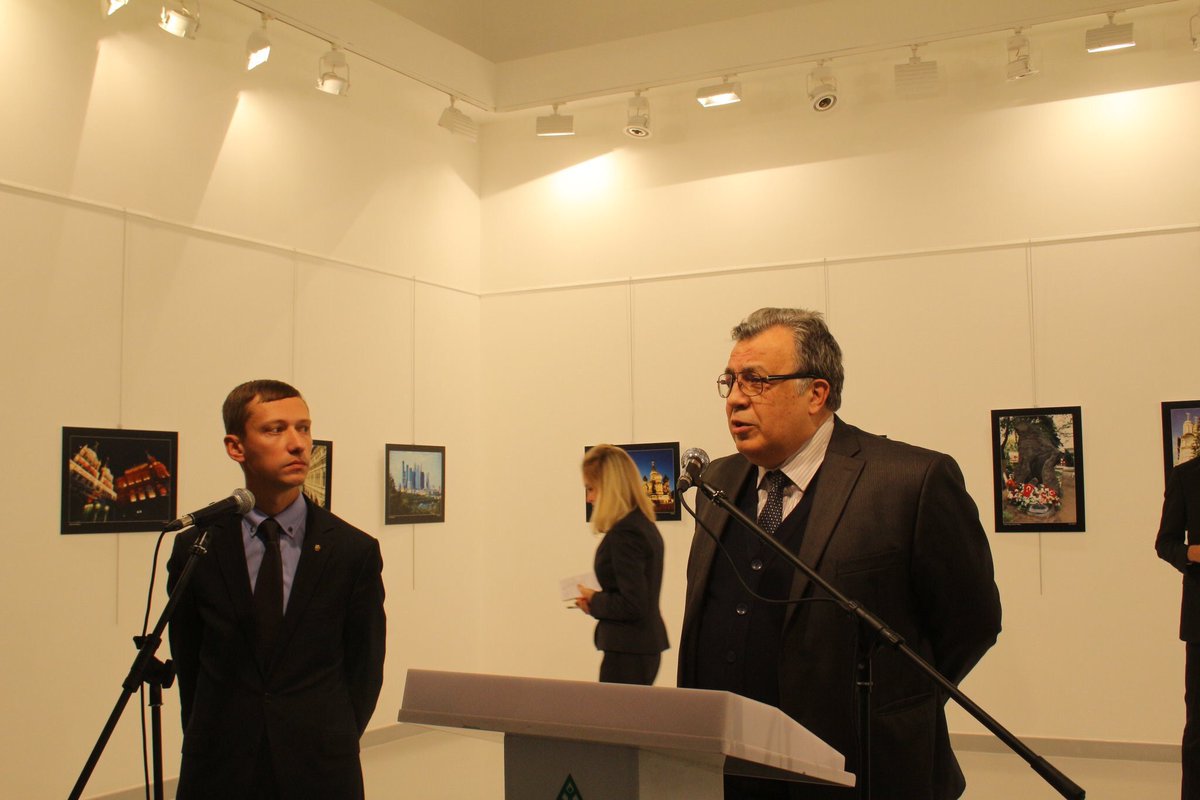
Hace pocas horas se acallaron los balazos del ex policía turco, el joven Mevlüt Mert Altintas contra el cuerpo del Embajador ruso Andrei Karlov en Ankara, en ocasión de su presentación de la exposición fotográfica "De Kaliningrado a Khamchatka", en pleno centro de la capital. 

En un ejemplo elocuente de una Rusia que hoy ejerce el "soft power" -vende su cultura al mundo-, el profesional de la diplomacia de Moscú, que insólitamente concurrió a inaugurar la muestra, sin escolta alguna, sólo acompañado por un traductor y un asistente, cayó asesinado, siendo el primero de la Rusia postsoviética, y el tercero desde la muerte de Piotr Voykov, el enviado soviético a Polonia, en Varsovia en 1927 y de Aleksandr Griboyedov, un poeta y diplomático muerto en disturbios contra la Embajada rusa en Teherán, la capital de Irán, en el siglo XIX.

Turquie : l'ambassadeur russe tué © Thomas SAINT-CRICQ, Laurence SAUBADU AFP


Resultado de imagen para photos Putin Karlov

El atentado juzgado como "terrorista" por las autoridades más altas de Rusia, entre otras, el propio Presidente Putin y la vocera de la Cancillería, Maria Zajárova, tomó de sorpresa a la Federación aunque no puede decirlo lo mismo para Turquía, que había sufrido ya, varios ataques recientes, tanto de ISIS como de los kurdos. Llama la atención la indefensión ya comentada del propio Embajador, una gran falencia de los aparatos de seguridad rusos que debieron haber estado mucho más atentos a tal vigilancia, en un contexto de tensiones previsibles pero también la propia inacción turca, que no podrá explicar cómo desprotegió a un diplomático de alto rango en pleno centro de Ankara, a pocas cuadras de la Embajada norteamericana.

Todo suena sospechoso en un contexto de relaciones entre Ankara y Moscú, tremendamente irregulares, frágiles y hasta pendulares. El famoso "cuchillo por la espalda" que citó Putin respecto al derribo del avión ruso Sukhoi el 24 de noviembre de 2015, en espacio aéreo sirio por parte de un caza turco, es una constante en el comportamiento turco desde la Guerra de Crimea en el siglo XIX, cuando el Imperio Turco Otomano no dudó en buscar el apoyo de las potencias occidentales como Inglaterra y Francia, para imponerse sobre el Imperio Zarista y el control geopolítico del Mar Negro. En la Primera Guerra Mundial, volvieron a chocar así como en la Guerra Fría, cuando ya en los años cincuenta, Turquía ingresó a la OTAN, para proteger los intereses norteamericanos y antisoviéticos en la región. Tanto Afganistán como Siria, fueron territorios de disputa geoestratégico para norteamericanos y soviéticos y en ambos casos, la República de Turquía, laica pero islamista al fin, se ubicó al lado de Washington por pura "Realpolitik". 

Cuando cayó la URSS, los viejos odios dejaron paso a una relación pragmática aunque sólo por dos décadas. La Federación Rusa llegó a acordar un "modus vivendi" con Ankara por el uso común de los recursos naturales del Mar Caspio, además de proveer ingentes ingresos al PBI turco, gracias al turismo ruso. Incluso, ya en el nuevo milenio, Turquía y Rusia, los dos únicos casos de ex Imperios que decidieron convertirse en Estados-Nación, vivieron trayectorias similares, con el ascenso al poder de dos "hombres-fuertes" (Erdogan y Putin), favorecidos por el "boom de las commodities", al frente de coaliciones heterogéneas, protonacionalistas pero sin rechazar la globalización o la integración con Europa, que no obstante, les negó la puerta abierta a ambos. 

Sin embargo, las viejas tensiones volvieron en ocasión de la guerra civil siria en 2011-2013, básicamente, por dos razones: una, la facciosidad identitaria intraislámica -los turcos sunitas pro wahabitas y Hermandad Musulmana versus los Al-Assad alawitas emparentados con los shiitas- y otra, las antiguas ambiciones imperiales de Ankara contra Siria, rivalizando con la defensa geopolítica de Rusia de su base naval de Tartus, negociada en los setenta con el padre de Bachir Al-Assad, en peligro, considerando la crisis ucraniana y las torpezas de Obama durante la "Primavera Arabe". 

En 2014 y 2015, Putin se cansó de intentar convencer -infructuosamente- a Washington y Bruselas, de que Erdogan no era un socio confiable en la guerra contra el terrorismo porque en Siria, anteponía sus propios intereses geopolíticos de defensa de la oposición armada, incluido ISIS y Al Qaeda a Al Assad y de represalia contra los rebeldes kurdos, que buscan un territorio propio separado de Ankara, pero que insólitamente, se habían erigido en la retaguardia de combate al propio Estado Islámico. Para Rusia, lejos de cualquier nostalgia militar expansionista, era y es clave derrotar a ISIS y salvar al Estado sirio como garante de la paz regional, al contrario del experimento Irak post Saddam Hussein, porque está y estaba en juego su propia lucha integración territorial, contra el secesionista emirato del norte del Cáucaso en el territorio ruso: Chechenia, Daguestán, Ingushetia, Osetia del Norte, Karbardino-Balkaria, la mayor parte de Karacháevo-Cherkessia y la estepa de Nogái.

El derribo del avión ruso hace un año y algunas semanas, tensionó la relación entre Moscú y Ankara al máximo, como en los viejos tiempos, blanqueando la oposición histórica. Putin sancionó con embargos alimentarios y turísticos al país de Erdogan, cuyo alto costo económico, obligó a éste a retroceder y pedir perdón por el trágico incidente. Fiel a sus convicciones, antes vio cómo toda Occidente lo aislaba y condenaba por su especial democracia y situación de DDHH, a propósito del golpe militar de la facción islamista radicalizada -pero insólitamente prooccidental- FETO liderada por Fethullah Gulen, exiliado en Estados Unidos y entonces, el líder del Kremlin, ofendido pero magnánimo, le tendió su mano una vez más, sin rencores. 

Sin caer en el reduccionismo de las hipótesis eurasianistas de un lado (Dugin) y del otro (Perincek), que creen absolutamente posible y deseable un eje Moscú-Ankara, en contra de Washington y Bruselas, pero que no pueden explicar ahora, fenómenos como el de Donald Trump y su predisposición prorrusa y antichina, que les rompe aquel esquematismo contrahegmónico, está claro que estábamos en medio de un acuerdo inédito entre Putin y Erdogan, cuando se produjo el atentado contra el Embajador Karlov. 


Wednesday, March 23, 2016

OBAMA Y MACRI - CONFERENCIA DE PRENSA


El discurso de Macri fue estructurado y puntual, acorde a su formación ingenieril: educación, empleo y narcotráfico. Definiendo a la actual, como la "sociedad del conocimiento", subrayó la relevancia de la formación y capacitación como medios para la inserción exitosa en el mercado laboral y profesional. En tal sentido, remarcó la sana envidia por una Estados Unidos, con 75 meses consecutivos de creación de empleo. Respecto al narcotráfico, hizo hincapié en las políticas de erradicación del flagelo y la colaboración y coordinación necesarias a tal efecto, con la Administración norteamericana.

Obama, si bien lamentó que serán Presidentes homólogos con Macri, apenas estos 9 meses, fue llamativamente más sentimental en su alocución y destacó la posibilidad de un esfuerzo y trabajos conjuntos, entre las burocracias de ambos países, más allá del final de su gestión. Declaró su admiración por el "apresurado" Macri, quien en 100 días, inclinó su gobierno hacia la rendición de cuentas, transparencia, atracción de inversiones, etc. En ese contexto y bajo este liderazgo, Argentina vuelve a tener la posibilidad de convertirse en el país líder que fue en el pasado, siendo un ejemplo para todo el hemisferio pero sobre todo, los países vecinos, en clara alusión a Brasil. Así como en el año 2005, tras la Cumbre de Mar del Plata, Brasil se erigió en el socio de la Estados Unidos de Bush (hijo), tras el "entierro" del libre comercio multilateral (ALCA) y la supervivencia del enfoque bilateralista, ahora es Argentina la que recobra cierta preponderancia al menos, simbólica, a través de las señales ofrecidas en estos primeros 100 días de la gestión Macri.  

Respecto al controvertido capítulo de golpes de Estado (40 aniversario del último en Argentina) y DDHH, Obama advirtió sobre la autocrítica norteamericana respecto al pasado y la madurez alcanzada hoy en las relaciones entre los países del continente en relación a esa triste historia. El Presidente americano citó el caso de Cuba, para demostrar que aun cuando hubieran valores e ideas diferentes de modelo social con la Administración Castro, se pueden expresar y disentir abiertamente y, ahora, con el objetivo claro de mirar al futuro, ya no al pasado. 

El final de la conferencia de Obama, tras sus citas a Borges, Cortázar y el mate, cuando estudiaba en la Universidad, fue un digno epílogo, demostrando así la coincidencia de valores comunes a ambos países, a pesar del distanciamiento de los últimos años. 

Sin estridencias, sin slogans, sin dogmas y, por el contrario, con una concepción pragmática y evolucionista de la relación bilateral, ambas conferencias ojalá preanuncien una nueva era de vínculaciones entre argentinos y norteamericanos, tras demasiados altibajos en la relación histórica.

EL TOWN HALL DE OBAMA CON LOS JOVENES EN LA USINA DEL ARTE


Tuesday, February 23, 2016

UNITED KINGDOM OUTSIDE THE EUROPEAN UNION?

THE MEANING OF BREXIT
AN INTERVIEW WITH IAN BREMMER


DAVID CAMERON completed his EU renegotiation just days ago and yet, as some of us predicted, already it is receding into the distance. As the campaign gets underway, the focus has moved off the prime minister’s respectable but inevitably modest achievements in Brussels and onto the big arguments. What would a Brexit mean for the country, and for Europe? Would it leave it stronger or weaker? What sort of role should Britain seek to play in the world over the coming decades? One particularly lively fault line in Westminster (albeit perhaps not on the doorsteps) divides those who would leave the EU to forge better relations with Anglophone and emerging powers on other continents from those who believe Britain’s EU membership is a stepping stone to the wider world. 

To help make sense of these choices, last week (as Mr Cameron was finalising his renegotiation) I sat down with Ian Bremmer, the president of Eurasia Group, a political risk consultancy, and a foreign policy guru. I asked him about what Britain’s decision on June 23rd would mean for its role on the global stage and why partners like the United States are taking such a close interest in the outcome. His answers together amount to a grave warning of the risks of an “Out” vote. 

Mr Bremmer argued that:

  • Brexit would bring the “further marginalisation of Britain as a power with influence”
  • the prospects of TTIP (the Transatlantic Trade and Investment Partnership) and the attractiveness of the British market would be hit “very dramatically” by Brexit
  • given the uncertainty about the EU’s future, now is a “very bad time for a referendum”
  • for that reason, and given the way the state is changing, it cannot be assumed that the referendum will settle the European question
  • another referendum in the medium term is a possibility
  • in a “world with more currencies” it is entirely possible for Britain to thrive in the EU without adopting the Euro
  • Britain should be doing “so much more” and “everything possible” to improve its relationship with India rather than obsessing about China, for which Germany will always be the best European partner
  • the notion of an “incredibly overbearing” EU getting in Britain’s way does not match the weak reality: “I really would not be very worried that the EU is stopping Britain from accomplishing so much”
  • Japan, not Britain, is best placed to sell services to the Chinese
  • by backing out of Europe and thus making itself a “second tier power”, Britain is undermining its own attempts to attract Chinese attention and investment 
  • it is dangerously short-termist for Brits to put “all of your eggs in the China basket”
  • London’s concentration on winning small concessions from Brussels illustrates its lack of ambition on the world stage: “The very debate that is being had over this referendum proves my point that Britain is not as relevant as it used to be”
  • Britain should be looking to set Europe’s course: “if you vote to stay in the EU the Brits can and should embrace a leadership role in what is a weaker Europe that needs Britain"
  • Brexit could put off Eurosceptics in other EU countries, because they will see how “painful” and “technically difficult to engineer” leaving the union is
  • Brexit would contribute to a much broader trend: the hollowing out of the transatlantic relationship and America’s associated turn towards the Pacific
NB: This interview has been lightly edited for clarity.

BAGEHOT: What would Brexit look like for Britain? What does it mean if we vote to leave?


IAN BREMMER: Well first of all it probably means a couple of years to unwind. The level of distraction, technically, to figure out how to do it with the Europeans is going to involve an enormous amount of political effort and resource, at the exclusion of many other things. We had a Supreme Justice who just died two days ago in the United States.


BAGEHOT: Scalia.

IAN BREMMER: Think about how much time that’s going to take; every other piece of legislation that you thought was relevant is suddenly thrown under a bus until they get through that discussion. Well, it’s that times ten. I think that’s one thing. The second thing is that it’s the further marginalisation of Britain as a power with influence, whether that is true diplomatically, economically or militarily (with the United States or more broadly). Now the US relationship is already weaker than it used to be, because the US see the Germans as generally more important and relevant, and the Brits have wanted to make themselves China’s best friends in the West. 

BAGEHOT: I joined George Osborne on his recent trip to Beijing. It was a whole different approach.


IAN BREMMER: It was quite something. I don't support that approach, for what it’s worth. But I do think, whether it means getting the TTIP done (which is important for the global economic architecture, the alignment of the West and trying to stop the fragmentation of values and standards in the international economy) or the attractiveness of the British market; all of these things will be hit very dramatically by Brexit. And that’s leaving aside the presumption that Scotland would leave Britain after Brexit (there would certainly be another referendum, because it reopens everything). So as much as I understand that Europe looks bad right now (and it does), I think that Brexit would be a truly unfortunate decision for the British nation.


BAGEHOT: Let’s pick over a couple of the counter-arguments put by the Eurosceptics. The first is that Brexit might seem like an uncertain prospect, but the status quo is not a known quantity either, in that Europe is changing, the Eurozone is trying to integrate, where Europe will be in five to ten years we don't exactly know…

IAN BREMMER: Sounds like a very bad time for a referendum. That is a very good argument for having the referendum when it is less politically expedient for Cameron. Unfortunately political figures are politicians, and that is their priority in all counts.

BAGEHOT: But Cameron having chosen to have the referendum now… What is the counter-argument to the “it’s riskier to stay in” objection?

IAN BREMMER: Have another one. If things get really ugly for you in five years time can’t you have another referendum? Are you legally blocked from having one?

BAGEHOT: Not at all, it’s up to the government of the day.

IAN BREMMER: Then explain to me why that argument [that Britain cannot hold another referendum in a few years] holds any water whatsoever. I just haven’t heard anyone actually say: “well why don’t you do one then”! I just don’t understand it. There’s nothing stopping you.

BAGEHOT: Eurosceptics would say that the Europhile establishment has somehow been pressured into giving us this referendum now, but that it won’t give us another one in five years. 

IAN BREMMER: If if becomes obvious that things are getting much worse… Look, I think it’s fair to say that the grounds for Euroscepticism have been getting larger over time. If Europe continues to deteriorate, that will not change. So it may be easier now to have a referendum than any time before - until tomorrow. I would think you would want as many referenda as possible. At the end of the day Quebec wasn’t satisfied with just one.

BAGEHOT: The “neverendum”.

IAN BREMMER: The neverendum! That’s right.

BAGEHOT: I think we need to use that word more. But you’re right: even if we vote to stay in by quite a large margin (which it might not be), the idea that this is going to settle anything is nonsense.

IAN BREMMER: It is! It’s dangerous to assume these things are settled. And I say that in particular because what it means to be a state is changing quickly. And that itself is going to have an impact on these discussions. There is so much decentralisation of power happening.

BAGEHOT: Within states?

IAN BREMMER: Within states. In terms of municipalities.

BAGEHOT: That’s certainly true here.

IAN BREMMER: And it’s true in the United States too. And in states in the United States. There’s just a lot of decentralisation. And I don’t see anything slowing that down. Again, in five or ten years time, if large democracies continue to see themselves as being controlled by special interests, incredibly ineffective, very slow moving, unable to respond to the demands of their constituents, then I think we have a whole different set of issues on our plate than the nature of Britain’s affiliation with the EU. You want to understand what the hell Britain is, and how it works. I think those are more fundamental questions.

BAGEHOT: To put another anti-EU argument to you, the Eurozone is going to have to integrate in some way, at whatever level. Britain is outside the Eurozone; Cameron claims to have some sort of protection built into the renegotiation. Formally, at least, every EU country but two (Britain and Denmark) is obliged to join the Euro eventually and although the likes of Sweden may take a long time about that it is possible to imagine a future in which the Eurozone and the EU look more and more identical. Admittedly, it’s quite an optimistic one from the Brussels point of view, but it is conceivable. Where does that leave a country like Britain, that looks extremely unlikely to join the Euro at any time in the next couple of generations? And a country that trades so much on its financial prowess?

IAN BREMMER: As long as you have a common market and the financial regulations themselves are more and more harmonised (between Britain and the rest of the European Union), then that actually allows London to stand quite significantly as a global financial centre. It is true that we are seeing more fragmentation, of the world over the long term, away from the dollar. Now in the last few years since the financial crisis the dollar has actually strengthened and more people have held it, but as the Americans unilaterally use the dollar as a tool of coercive diplomacy and use financial institutions (what I call “the weaponisation of finance”), lots of people are going to hedge. And they’re going to hedge towards the RMB (particularly as they [the Chinese] reform more). It’s going to be a world with more currencies. And I don’t necessarily believe that means that it’s a mistake for Brits to want to be in the EU but not have the Euro. I think that’s OK.

BAGEHOT: On that point about the country’s place in the world, some say Britain should cut itself free from the sclerotic EU and use the freedoms that it wins by leaving the union to build better relationships with the rising markets, with the Commonwealth. For example, because we get so much immigration from the European countries we can’t take as many computer engineers from Bangalore, or whatever. Do you see any merit in that argument? In the idea of Britain as a truly global rather than European player, aided by leaving the EU?

IAN BREMMER: I think the Commonwealth is extraordinarily important to Britain, and the Brits should invest more in it. The very fact that they decided to spend less on the Foreign Office and were able to coordinate their embassies and share resources with the Canadians and the Aussies and the Kiwis… I would have preferred it if the Brits had spent more themselves. But I’d still want them to be doing that sharing. I think it’s hugely important, like the Five Eyes agreement on cyber, which has been very helpful to the United States as well. You look at Britain’s ability to develop a stronger relationship with a country like India, given its ties, and it should be doing so much more. Because India is a rising country, a vibrant democracy and is finally starting to get governance in place. Right now the best relationship India has in the world is with Japan. Britain should not be happy about that. Britain should have been doing everything possible to get in that position; as opposed to China, where the Brits are never going to be able to compete with the Germans. The Germans will always have a better relationship with China than Britain.

BAGEHOT: But are you convinced that Britain staying in the EU doesn’t inhibit that?

IAN BREMMER: Not to a meaningful degree. Not to a degree that matters, compared with the dangers and downsides of leaving. Let’s be honest with ourselves: it’s not like the EU is getting stronger. The EU is getting weaker. Schengen is falling apart and countries are increasingly looking to themselves. Common values in Europe are falling apart. So in the EU that the Brits are thinking about leaving—because ostensibly it is so incredibly overbearing—those things are eroding. Europe doesn’t stand for what it used to. I happen to think that’s sad, because of course the supra-national, democratic identity that Europe took on was in many ways the most bold and courageous experiment that advanced industrial democracies have ever embarked upon. They failed. And you see that in Europe with governments moving away from rule of law, moving away from an independent judiciary. You see it in Hungary, in Poland, in Greece. You see it with the rise of populism in many of the larger European economies as well. In this regard, I really would not be very worried that the EU is stopping Britain from accomplishing so much.

BAGEHOT: You mention India and China. The argument for the great Osborne charm offensive towards the Chinese is that their economy is evolving: where once it had a seemingly unquenchable thirst for the machine goods, the hard engineering exports, in which Germany specialises, now as its middle class grows, as it starts building up a welfare state, Britain’s strengths come into play. Financial, educational, business services are suddenly a larger part of China’s imports. And Osborne’s thinking is that now is therefore the time to try and beat the Germans at their own game. What’s the counter argument?

IAN BREMMER: There are a few. One is that the Chinese take advantage of you when they think you’re desperate. And the Brits smacked of desperation a bit. Not just in joining the AIIB [the Asian Infrastructure Investment Bank] but joining it first and saying: “you see, we made this happen for you.” They drive tougher commercial bargains when that happens. The second point is that, long-term, the major economy that the Chinese will ultimately need the most is not Britain. It is Japan. Because Japan has by far the oldest population, they have a healthcare system that really works, they’ve got the most resilient infrastructure in the world. They know how to market to a much older population, develop consumer goods for it. And they’re right there. So good luck to Britain on that one. 

The third point is that, unlike Germany, the Brits actually play a geopolitical role. The Brits are much more interested in talking about human rights internationally, things like the Dalai Lama, Taiwan, Hong Kong. It is true that, for the time being, you have a British government that has jettisoned all that in favour of the Chinese. What happens when the next British government gets elected? Is Cameron able to promise that everyone who comes after him is going to have an equally benign view of a communist China? The Chinese absolutely know that what the Germans do is industrial policy. That’s what they focus on. So the Chinese feel much more certain, long term, that the Germans are not just a good bet; they’re a safe bet. Not only are the Brits not as good a bet, but they’re a very unsafe bet!

BAGEHOT: Let me play devil’s advocate. Britain is progressing towards a less geopolitically significant role. You’ve been saying that in this interview.

IAN BREMMER: Yes, I agree.

BAGEHOT: Meanwhile Germany at least seems to be aware of the fact that there is now more pressure on it, more expectation of it, to lead. The US picks up the phone to Germany rather than Britain for a reason. And OK, Cameron can’t bind his successors, but it looks like the Tories will be in power for quite a while. Aren’t we moving towards a place where Britain can play Germany at its own game?

IAN BREMMER: We are. I think those are both really good points. But I also think that you aren’t going to change a country’s stripes over a couple of years. This British charm offensive was virtually overnight. And British role on Hong Kong and Taiwan lasted a little longer than that. Those are places that are going to get more problematic over time. Yes, the Germans will play a more significant—even military—role. But the British role is more significant militarily in NATO, in the Middle East than Germany’s is today, and it will be in two years and in five years. The fact that the Americans are closer to the Germans is not because the Germans are doing so much militarily. In fact, in part it’s because Obama is becoming more German and the United States is moving in that direction. And also because Germany is clearly the leader of Europe, which by the way is the same reason the Chinese want to be with Germany; if you can make only one stop in Europe where do you go? You’re going to go to where things matter. To whoever’s taking a leadership role. 

The Brits are basically saying: you know what? We’re a second-tier power. Well the Chinese are very likely to take you as a second-tier power. And that’s not where they spend their money, it’s not where they spend their time. Let’s not pretend China is changing its SOE [state owned enterprise] stripes overnight, and the relationships that they continue to have with the big German manufacturers are going away; there’s still an awful lot the Chinese want to learn from and steal from them. And in that regard the fact the Brits are very aligned with the Americans on things like cyber, and the Germans are not, is also useful from the German perspective. Huawei can get into Germany.

BAGEHOT: Ironically one of ways the Germans are different to the Brits is their wariness about the surveillance state. Funny how these things work out.

IAN BREMMER: It is. It’s very ironic, is it not. Look, I’m very sympathetic to the Cameron-Osborne notion that Britain needs to have much better relations with rising powers. I’m very sympathetic to the notion that the Brits need to hedge and that the United States right now doesn’t really know what it is. And so the Special Relationship is not all that special. I get that. I think the China decision is a mistake. What you do is not put all of your eggs in the China basket. What you do is you play very hard with the fact that you’ve got the Commonwealth, in India and you basically do what the Japanese have been doing, which is that you go around planting flags and engaging. But it really should not be: “hey, the Chinese are writing cheques so let’s get the money now.” That’s a short-term strategy. That’s the kind of thing you do if you are the CEO of a company and are planning to retire in a couple of years. It’s not what you do if you’re the prime minister of a country and are looking for your legacy.

BAGEHOT: I think they’re almost explicit about that comparison: the chief-executive prime minister going around cutting deals and flogging British goods.

IAN BREMMER: That’s the problem. The average CEO lasts for less than five years, so they’re all looking at: what do we do to ensure we maximise shareholder value for now? How to we pump those stocks? Gotta make sure we make that money and right now. Doesn’t matter what it means in five or ten years. The problem is the British people are around longer than shareholders. And you can’t do that to your constituents, to your voters. That’s why this is not something they should be embracing. 

BAGEHOT: You mentioned the idea that Britain is becoming marginal and a “second-tier power”. To put the counter-argument, it’s spending its 2% of GDP on defence, it is an international aid superpower, Osborne has stopped the haemorrhage of funds out of the Foreign Office. Britain is still on the UN Security Council, we’re still in the EU. Is it exaggerating to say that the country is pulling back from the world?

IAN BREMMER: Philip Hammond’s speech at Munich was a hell of a lot better than the British statements last year. So I do think there’s something to it. I’m the one who tweeted that the most influence Britain has these days is what’s written in The Economist. And I meant it. Precisely because that is soft power, it does matter and Britain is seen as much more relevant on stuff that it has done for a long time than on what the British government is coming up with these days. The fact that you’re in the Security Council? Who cares. It’s an irrelevant, feckless organisation. 

Look, I think that there’s something to be said: if you vote to stay in the EU the Brits can and should embrace a leadership role in what is a weaker Europe that needs Britain. That needs Britain. Why is it that this entire debate is only about what Britain needs? That shows how much smaller Britain has become.

BAGEHOT: Insecure? 

IAN BREMMER: The very debate that is being had over this referendum proves my point that Britain is not as relevant as it used to be. It needs to get beyond that and say: Britain can be there for others and the Europeans need Britain. The Europeans really need Britain. The Germans, Merkel, need Britain. The French need Britain. The Italians need Britain. And Britain’s not there. Britain doesn’t care. (They need America too, and America’s not there.) Is that the world we want? I wrote about the “G-Zero”, so I’m fully invested in the fact that that’s the way the world is going. But I don’t like it. I don’t think it’s good. I don’t think it’s good for Britain.

BAGEHOT: At the start of this I asked you what Brexit would mean for Britain. What would it mean for the rest of the world? Why is there so much concern in Washington?

IAN BREMMER: There isn’t enough concern in Washington about this! Kerry made his first significant statement on this in Munich.

BAGEHOT: A “strong UK in a strong EU.”

IAN BREMMER: Exactly. And Obama’s going to make a statement, I’m sure. But this has been irrelevant to the Republican and Democratic primaries. There’s been a lot of debate on foreign policy but not on the transatlantic relationship. We [Eurasia Group] set out our top risks for this year and number one was the “hollow alliance”. We believe that it is weaker than at any point in the last 75 years. And it’s precisely because of all the dangers around the EU, including Brexit, that we wrote that. The Trans-Pacific Partnership, I think, is the single biggest thing Obama has done in seven years on foreign policy. It’s something that not only brings America closer to like-minded countries in the Pacific, but it will also, ultimately, help the Chinese integrate in that direction as well, because they don’t want to be left out. Let’s keep in mind that America is relatively new as an Atlantic power. Before World War Two it was focussed more on the Pacific. And it will be again, and it will be much more if Britain leaves the EU.

BAGEHOT: So Britain leaving the EU would help the “pivot”?

IAN BREMMER: Absolutely. The Europeans will be seen as less relevant as allies to Americans. Especially because so many bad things are happening in Europe. All of the geopolitical issues that don’t wash up onto American shores. People say they do, but ISIS is so much less of a problem for America than it is for Europe. Britain leaves the EU, and that is going to be even more so.

BAGEHOT: The fact that Trump is concentrating on Mexicans is telling. 

IAN BREMMER: Sure. That’s because we have an ocean; where with Mexico there’s actually a border.

BAGEHOT: Do you think that Brexit would create a domino effect in the EU?

IAN BREMMER: I certainly believe that other countries would look into having their own referenda; that that political process would gather steam. I don’t necessarily think that Britain leaving would suddenly lead to a wave. I don’t think it would lead to the end of the EU. Because people will also see how painful it is. And they’ll also see how technically difficult it is to engineer. I think that will scare them.

BAGEHOT: How do you think Cameron has handled this whole issue?

IAN BREMMER: He’s a strong prime minister. The Labour Party has imploded. His alliance with the Lib Dems has left the Lib Dems much the worse for it. I think you could say that politically he has handled things extremely well. His cabinet is mostly behind him. He’s a strong premier. But in terms of what that’s meant for Britain as a country, I think it has come off the worse. 

BAGEHOT: Ian Bremmer, thank you.

IAN BREMMER: Thank you.