Thursday, December 18, 2014

LAS SEÑALES POLITICAS DE PUTIN ANTE LA CRISIS DEL RUBLO

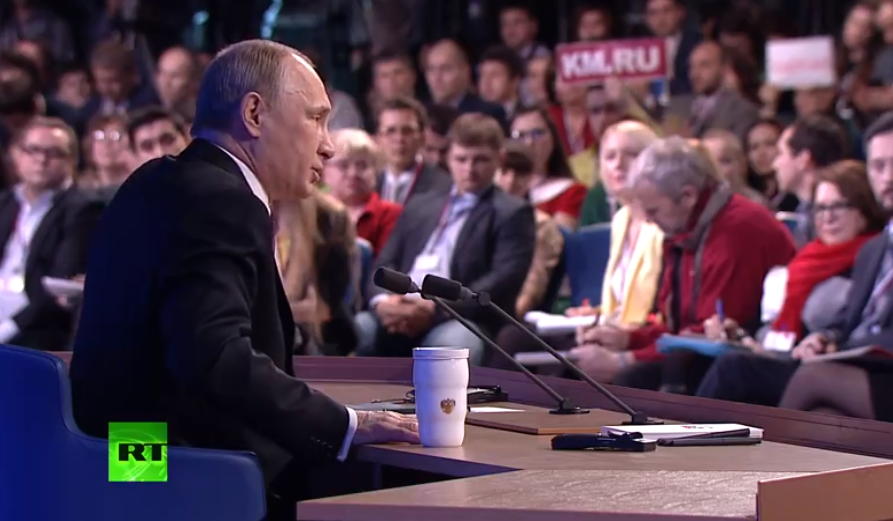
Putin acaba de hablar con la prensa nacional e internacional, en el contexto de una de las semanas más difíciles de los últimos años, tras varios meses, más que preocupantes. Hubo intensidad a lo largo de todo este 2014 que culmina, para los rusos a propósito de la crisis ucraniana que rozó al país y que para no pocos, asoma, como el verdadero responsable, teniendo en cuenta su pésima reputación imperialista con sus vecinos, pero desde hace días, esa turbulencia se multiplicó por diez, en ocasión de la baja del precio del petróleo y la caída del rublo, a raíz de la desconfianza de los mercados. A pesar de todo ello, el líder ruso ha mostrado tranquilidad en su postura y su discurso ante 1.300 periodistas. Sabe que su acceso al poder y su consolidación a lo largo de estos largos 14 años, pero sobre todo, su propio futuro y el de Rusia, inextricablemente ligados, dependen de cuán firme aparezca ante las presiones, las externas, la de los antiguos rivales que parecen persistir aunque ya no lo sean, pero también los internos, siempre agazapados, algunos lobbies, pero también sectores políticos, como los nacionalistas y los comunistas, que lo han apoyado a regañadientes hasta aquí, pero que seguramente lo abandonarán, cuando se generen las condiciones para una tormenta perfecta, como las de estas horas. Rusia ya ha vivido crisis semejantes a la actual, en el '92 y en el '98 y a diferencia de aquéllas, la inflación todavía no ha escalado aunque lo hará en las pròximas semanas. El apoyo sostenido y sistemático de Putin a la gestión de Nabiullina en el Banco Central de Rusia, será decisivo, para testimoniar la dureza del gobierno frente al ataque de los mercados, que seguirán apostando contra el rublo, a pesar de toda suba eventual de la Bolsa de Moscú. Luego, deberá ser consecuente con su discurso de hoy. Reconcentrar fuerzas en el frente interno, controlar el gasto, vender activos y diversificar la economía y el comercio exterior, es decir, intensificar todo lo que se postergó en estos años, cuando se disfrutó de las mieles siempre transitorias del boom petrolero. Así, Rusia podrá salir de sus crisis en dos años, como dijo el líder del Kremlin o tal vez, menos. Pero si lleva adelante las reformas estructurales que demoró hasta hoy, Putin podrá llevar a Rusia, al sitial donde merece, en términos económicos y de la calidad de vida de sus habitantes. Esa será la mejor manera de demostrarles a los mercados, cuán equivocados están con la Federación y a Washington y Berlín, que sus sanciones y conspiraciones, no harán mover a Rusia de sus líneas rojas. 

View image on Twitter

Wednesday, December 17, 2014

YOANI SANCHEZ, LA LIBERACION DE GROSS Y EL DESHIELO USA-CUBA

Alan Gross, el anzuelo que terminó siendo tragado

La periodista Yoani Sánchez analiza el deshielo en un artículo publicado en '14 y medio'

 La Habana DIARIO EL PAIS, MADRID17 DIC 2014

Con ese pesimismo que se ha vuelto ya crónico en nuestra sociedad, muchos cubanos pensábamos que Alan Gross solo lograría salir de Cuba "con los pies por delante", en una imagen alusiva a un desenlace fatal. La terquedad que ha mostrado el Gobierno cubano en sus relaciones con Estados Unidos, no presagiaba una solución a corto plazo para el contratista. Sin embargo, este miércoles ha sido canjeado por tres espías cubanos presos en Estados Unidos, con lo que se cierra un largo y complicado capítulo político para ambas partes.
Gross solo era de utilidad vivo y su salud se deterioraba muy rápidamente. Y eso lo sabía muy bien Raúl Castro. De ahí que en los últimos meses le aumentara los decibeles a la propuesta de intercambiarlo por el agente Antonio Guerrero y los oficiales Ramón Labañino y Gerardo Hernández que cumplían largas condenas en cárceles del vecino del Norte. En la medida que el contratista de 65 años enflaquecía y perdía la vista, las campañas oficiales insistían más en el canje. Cuando Gross amenazó con quitarse la vida, las alarmas se dispararon en el Gobierno de la Isla y el cronograma de la negociación se aceleró.
Para quienes conocemos los mecanismos de presión que utiliza la Plaza de la Revolución hacia sus contrincantes, la propia captura de Gross queda como una jugada dirigida a recuperar a los agentes del Ministerio del Interior. El contratista no fue arrestado tanto por lo que hacía, sino por lo que se podría lograr con él. Era un simple anzuelo y estaba consciente de ello desde el principio. Su delito no radicaba en haberle traído un equipo de conexión satelital a Internet a la comunidad judía cubana, sino en llevar en su bolsillo un pasaporte que lo convertía de inmediato en una pieza de cambio en el tablero de las tensas relaciones bilaterales entre Washington y La Habana.
Barack Obama, por su parte, tenía claro que cualquier cambio en la política hacia La Habana se encontraría ante el obstáculo insalvable de un estadounidense preso por "amenazas a la seguridad del Estado". Ya el propio The New York Times había sugerido el intercambio en uno de sus editoriales sobre Cuba, y la publicación del texto en tan prestigioso diario fue leída como un adelanto de lo que ocurriría. Como en todo juego político, solo veíamos una parte, mientras en los entresijos del poder se ataban los hilos del acuerdo que hoy acaba de hacerse público.
Si se revisan los cinco años de cautiverio padecidos por Gross, se verá un estudiado guión informativo con que el Gobierno cubano ayudó a presionar a la administración Obama. Cada imagen que salió a la luz pública, cada visitante al que se le permitió verlo, fue autorizado con la única condición de que reforzaran la tesis del canje. De esa manera el castrismo ha terminado por salirse con la suya. Ha logrado intercambiar a un hombre pacífico, enrolado en la humanitaria aventura de proveer conectividad e información a un grupo de cubanos, por agentes de inteligencia que causaron daño significativo y dolor con su accionar.
El castrismo ha ganado, aunque el resultado positivo es que Alan Gross ha salido con vida de una prisión que amenazaba con convertirse en su tumba. Ahora, nos esperan largas semanas de vítores y consignas, en las que el Gobierno cubano se proclamará vencedor de su última batalla. Pero no hay espacio en el panteón nacional para tanto héroe que respira y, poco a poco, los recién llegados agentes irán perdiendo importancia y visibilidad. Empezará a desteñirse el mito que les labraron en la distancia.En el juego de la política los totalitarismos logran imponerse a las democracias, porque controlan la opinión pública al interior de sus países, determinan los resultados legales a su antojo y pueden mantenerse tres lustros gastando los recursos de toda una nación en aras de liberar a sus topos enviados al terreno del adversario. Las democracias, sin embargo, terminan por ceder porque tienen que darle respuestas a los suyos, vivir con una prensa incisiva que le reprocha a los gobernantes el tomar o no tomar ciertas decisiones y porque están obligadas a hacer todo lo posible por llevar sus muertos y sus vivos de vuelta a casa.
Eliminado el principal obstáculo para el restablecimiento de relaciones, solo falta saber cuál será el próximo paso. ¿Planea el Gobierno cubano otro movimiento para volver a estar en posición de fuerza con el Gobierno de Estados Unidos? O por esta vez todas las cartas han quedado sobre la mesa, ante los cansados ojos de una población que presiente que el castrismo volverá a ganar también la próxima jugada.
 Yoani Sánchez es una periodista cubana. Este artículo fue publicado el 17 de diciembre en la página web '14 y medio'.

ANTISEMITISM IN EUROPE

Europe’s New Problem With Anti-Semitism

Anti-Semitism isn't just a problem for Europe's Jews. It's a problem for Europe.

By Elisa Massimino, Foreign Policy, December 16

Europe’s New Problem With Anti-Semitism
July 11, a mob firebombed a synagogue outside Paris, one of eight anti-Semitic attacks in France that week. Later that month, attackers threw Molotov cocktails at a synagogue in Wuppertal, Germany, and in Hamburg thugs beat an elderly Jewish man at a pro-Israel rally. Those attacks, among many others this past summer, followed the shooting in May that killed four people at the Jewish Museum of Belgium in Brussels. “These are the worst times since the Nazi era,” Dieter Graumann, the president of Germany’s Central Council of Jews, told the Guardian in August.
Several factors, including the intensifying violence in the Israeli-Palestinian conflict, have contributed to the resurgence of anti-Semitism across Europe. But perhaps none is as toxic or frightening as the ascendance of far-right political parties. These groups are not just bad for Jews; they are bad for Europe. The ascendant far right are equal-opportunity haters, demonizing Muslims, Roma, sexual minorities, socialists, and immigrants, as well as Jews. They openly promote hatred, division, and exclusion, threatening the economic and political systems of countries still reeling from the financial crisis. And as the formation of a far-right block in the European Parliament becomes more likely, the risk that these parties will destabilize not only their own countries but the European Union itself — a crucial U.S. ally and trading partner — is serious. 
Parties like France’s National Front and the Party for Freedom in the Netherlands aren’t merely Euroskeptics — they are Euro-enemies that oppose the very ideals that undergird a unified Europe. Ranging from nationalist to openly fascist, these parties receive relatively little public support. But in countries like Hungary and Greece, they have exploited economic distress and anti-immigrant animus to become influential, and not only at the national level. In elections in May, 59 far-right candidates from 14 countries won seats in the European Parliament. Ruling parties in many of these countries have been negligent at best in opposing extremists. At worst, they have indulged and empowered them.

Ostensibly opposed to the far right, mainstream politicians have embraced some of their policies and played to the prejudices fueling them. That’s precisely what’s happened with Hungary’s Jobbik party, which describes itself as the EU’s “most successful radical nationalist party.” Already the second-strongest party in Hungary, Jobbik’s popularity continues to grow. Last spring, it won three seats in the EU Parliament and, after obscuring its extremist ideology with an anti-corruption message, won more than 20 percent of the vote in national parliamentary elections. But there should be no mistaking the party’s true nature: In 2012, one of its leaders called for a list of Jews in the government, claiming they pose a national security risk. Another claimed that the “Israeli occupation” that controls Hungary uses the Roma as a “biological weapon.”Pollster Andras Kovacs notes a “clear correlation” between Jobbik’s rise and the prevalence of anti-Semitism in Hungary.
Prime Minister Viktor Orban and his ruling Fidesz party were evidently taking notes. Since his election in 2010, Orban has essentially co-opted parts of Jobbik’s agenda, promoting Hungarian ethnic nationalism as part of a broad move to the right. By the end of 2012, Fidesz had implemented 12 of Jobbik’s policy priorities, including a measure requiring students to visit“Hungarian territories seized from us” and a Roma-targeted measure requiring home inspections of people receiving social welfare benefits. Orban has also come under fire from Hungarian Jewish groups for commissioning a World War II monument that ignores Hungary’s complicity in the Holocaust. “There are no longer any clear boundaries between the thinking of Fidesz and Jobbik,” says historian Gyorgy Dalos.
Meanwhile, Orban plays a double game, denouncing anti-Semitism one moment and catering to it the next. At a 2013 meeting of the World Jewish Congress (WJC) in Budapest, Orban condemned anti-Semitism but rejected WJC’s call to criticize Jobbik. And in the summer, he selected a notorious anti-Semite, Peter Szentmihalyi Szabo, to serve as ambassador to Italy. Facing criticism, Szabo ultimately withdrew from the position. But by selecting him, Orban delivered a message of solidarity with the far right.
It’s difficult to know whether these moves have sparked an increase in violent hate crimes, since the Hungarian government, like many in Europe, fails to keep reliable statistics. But there is no doubt that the mounting ethnic nationalism and anti-Roma rhetoric are exacerbating hatred that has already led to a number of violent attacks. A spree of hate crimes in 2008 and 2009 killed six Roma Hungarians, including a 4-year-old boy, and wounded 55 people. Nearly all were Roma.
Some 600 miles to the south, in austerity-ravaged Greece, Jobbik and Fidesz may have met their match in fascism. Golden Dawn, an overtly Nazi-glorifying party, came in third in both Greece’s 2012 national elections and the 2014 European parliamentary elections, despite promoting views so extreme that even Jobbik refuses to ally with the group. In Greece, where there are fewer than 5,000 Jews, anti-Semitism is less part of a practical program than a marker of white supremacy — a sign of fascist street cred.
No European party of comparable size is as openly anti-Semitic as Golden Dawn. Ilias Kasidiaris, a member of the Greek parliament and a leader of the party, reportedly sports a swastika tattoo and has read from the notoriousProtocols of the Elders of Zion — a piece of early-twentieth-century anti-Semitic propaganda that describes a fake plan for Jewish world domination — on the floor of the parliament. “We are ready to open the ovens,” said one Golden Dawn parliamentary candidate in March 2013, expressing his desire to purge Greece of migrants. “We will turn them into soap.”
While taking measure of the group’s brutality is difficult due to the negligence or alleged complicity of law enforcement, reports implicate Golden Dawn in beatings, torture, and murder of migrants and other minorities. A 2013 investigation by a Supreme Court deputy prosecutor reported that the party’s “operational” wing is specifically charged with carrying out violent attacks against those deemed the party’s enemies.
Prime Minister Antonis Samaras and the ruling center-right New Democracy Party were slow to confront Golden Dawn. New Democracy officials, in fact, use Golden Dawn members as bodyguards, and there are reports of an ongoing relationship between the parties, as well as evidence that Golden Dawn has received the support of business executives, the police, and bishops in the Orthodox Church. In August, Human Rights First released a report that uncovered some of these connections, including a New Democracy-affiliated businessman’s funding of Golden Dawn.
Late last year, the government finally launched a criminal investigation of Golden Dawn. In October, authorities recommended indicting 70 people, including all of Golden Dawn’s MPs, in connection with violent attacks against immigrants. But even if these prosecutions are successful, it’s unclear whether they will stunt Golden Dawn. While the government should be commended for finally recognizing the threat to public safety posed by the party and acting accordingly, some say it is nothing more than a politicized effort to harm a rival. To make matters worse, a video leaked in the spring showed an aide to the prime minister telling Kasidiaris that his boss initiated the criminal probe because he feared losing votes to Golden Dawn.
It’s no coincidence that Jobbik, Golden Dawn, and most extremist parties in Europe support Russia. (Golden Dawn Leader Nikolaos Michaloliakos says Greece and Russia are “natural allies.”) The far right shares President Vladimir Putin’s espousal of “traditional” values and his opposition to the EU and the United States. And despite Russia’s historic anti-fascism, Putin has good reason to return the support — and the anti-Semitism of his far-right allies doesn’t appear to be a deal-breaker. Political scientist Mitchell A. Orenstein says Putin hopes to “destabilize his foes and install in Brussels politicians who will be focused on dismantling the E.U. rather than enlarging it.” Recently, France’s National Front — whose leader, Marine Le Pen, has effusively praised Putin — received a major loan from a Russian bank. (Le Pen has been trying to cleanse her party of its well-earned reputation for anti-Semitism, an effort that suffered a blow in June when her father, National Front founder Jean-Marie Le Pen, “joked” that Jewish singer Patrick Bruel should face the ovens.) In Russia, even private banks are overseen by the central bank, so it’s unlikely that the Kremlin did not have hand in the loan. The New York Times reports that the loan is “yet another sign of growing closeness between Europe’s far-right parties and Russia.”
It’s clear that these far-right parties threaten more than the marginalized populations they rail against. They threaten Europe and they must be curtailed. Strong efforts to monitor, investigate, and prosecute hate crimes will help. 
Ruling politicians and parties should also actively oppose with both rhetoric and actions the resentments on which far-right parties feed, from Islamophobia to anti-Semitism to anti-immigrant animus. Perhaps most daunting of all, European governments must improve the dismal economic conditions that make far-right parties appealing to the disaffected. But few, if any, European governments have these capabilities. And those that do seem to be losing their resolve.

In November, European governments gathered in Berlin to commemorate a 2004 agreement to make concrete steps to stem the tide of anti-Semitic violence, such as legal reforms and Holocaust remembrance programs. U.N. Ambassador Samantha Power, who led the U.S. delegation, struck the right note, calling anti-Semitisman “insidious threat to the European liberal ideal that rose up when the Berlin Wall came down.” Yet her European counterparts don’t seem up to the challenge: Only a third of the countries that sent a foreign minister or other cabinet-level official in 2004 bothered to send one in 2014.
It is not 1939 in Europe. But the recent rise in anti-Semitism is a serious human rights problem, and unless the governments there get serious about opposing extremism, it’s going to get worse. European governments are kidding themselves if they believe they can be complacent about anti-Semitism and its purveyors without weakening their democracies and the social fabric of their countries. The failure to tackle this problem head-on will lead to weakened countries, a weakened EU, a weakened trans-Atlantic partnership, and a strengthened Russia. Those are outcomes none of us can afford.
ARIS MESSINIS/AFP/Getty Images
Tuesday, December 16, 2014

PSYCHOLOGY AND INTERNATIONAL RELATIONS

Time to Make Psychology a Part of International Relations


Cultural studies, sociology and psychology are not fluffy, useless subjects. They are serious, underrated subjects that need to be given a more central role on the international-studies stage.
Everyone has knowledge gaps. Take it from Ted Mosby in an episode of “How I Met Your Mother.” Despite being an intelligent professor of architecture, Mosby mispronounced “chameleon” his whole life, and when he uses it in a lecture, his students can’t help but chuckle. Similarly, I pronounced the “b” in “subtle” for a long time as a kid. My mother, bless her heart, corrected me at age fourteen, sparing me more embarrassment later in life. Some knowledge gaps are comical and not cause for concern. Others require serious attention and demand filling. One such knowledge gap for international-relations experts lies in the realm of psychology. There is a strong need for a psychology requirement for all international-relations, strategic-studies, security-studies, public-diplomacy majors and so forth, but it seems to go largely overlooked.
If we liken the human brain to a computer, the need for a psychology requirement in international-relations curriculum becomes simple and clear. If one wanted to become a computer technician, it would follow that one would take a few courses on how computers work, yes? So if one wanted to become, say, a diplomat, a political analyst, an academic, a foreign-service officer, a State Department employee and so on—in short, someone whose job it is to know how political and economic systems function (because they do not function of their own volition or in a vacuum; humans are at the root of politics, naturally), offer up solutions on how to improve the functionality of those systems and help manage relations with the rest of the humans in this world—would it not also follow that one should be well versed and well learned in how humans work? After all, how useful are our leaders and ambassadors (notwithstanding other reasons for questioning the appointments thereof) at facilitating good relations with leaders of other nations if they are not experts in human behavior? 
At the very least, anyone engaging in serious negotiations with leaders of another country should be extremely knowledgeable about that country’s culture, including the nuances and patterns in psychological and sociological behavior that are prevalent in that country. For example, one leader whose behavior seems to have vexed most U.S. politicians as of late is Vladimir Putin. Nina Khrushcheva, the granddaughter of former Soviet Union premier Nikita Khrushchev, offers up a few works of literature, including Gogol’s Taras Bulba, that she believes give insight into Putin’s behavior and motivations for getting involved in Ukraine’s political affairs and annexing Crimea. Khrushcheva, a longtime Putin watcher and accomplished academic, uses her extensive knowledge of comparative literature, politics and Russian culture to try and understand why leaders such as Putin behave the way they do. Perhaps if some of our top leaders bothered to learn about Russian culture and how it manifests itself in Russian politics and foreign policy, we would have a better shot at repairing relations with one of the largest and most influential countries in global politics. (The onus is also on Russian leaders to understand U.S. leaders, but that does not make it any less critical for U.S. leaders to understand Russian leaders.) The last thing we need is our own president making any more misinformed comments about countries upon which he claims to be focusing. It seems that Obama knows very little about the aspects of Russian cultural and psychology that influence and motivate Putin’s actions. Further, the issues raised in Kenneth Yalowitz and Matthew Rojansky’s article about the demise of Russian and Eurasian studies in the United States seem indicative of just how little we care about establishing good diplomatic ties with Russia’s leaders and how little importance we place on understanding the psychological motivations behind their actions.
It begs the question: Why is it that so many people playing the international-politics game do not have a solid educational background in psychology?
Sure, game theory and economic theory analyze concepts related to psychology and the human psyche (think prisoner’s dilemma, for example). The problem is that many students of international relations (myself included, admittedly) take only a few courses on theory and discard the knowledge as too abstract or useless, career-wise. This couldn’t be further from the truth. In fact, psychology should be a fundamental requirement for completion of any international affairs/relations/studies major relating to diplomacy and international politics. While some university programs, such as those atHarvard’s Extension School, offer one or two psychology courses that can count toward international-relations course credit, this is completely different from having a whole module—consisting of maybe three or four courses—that is required to be taken by those majoring in international relations, be it at the undergraduate or graduate level. The College of William and Mary offers a few options for sociology and psychology courses that are optional for undergraduate international-relations majors, but does not include any of these in the core requirements. Disappointingly, Georgetown’s School of Foreign Service’s course options for international-politics majors do not include a single psychology course. On the slightly brighter side, they do have a cultural and politics major that offers one psychology course: cultural psychology. But again, there need to be better options, more options and a core requirement. With its reputation in international relations, Georgetown would be the perfect candidate to spearhead the pivot toward psychology as a core requirement.
Let’s take all the international-relations majors and throw them into structured, advanced psychology courses; the boiled-down, psychology-lite courses offered to students of international relations–related majors in the form of IR theory are not enough. If psychology were a mandatory requirement, we might all be making observations like that of Arie Kruglanski,a psychology professor who brilliantly explains in an easy-to-understand way a driving force behind people’s reactions to different types of leaders.
U.S. leaders are always claiming to be serious about facilitating peaceful relations with difficult or adversarial nations. It seems to me that if this really is the mission, then there should be clearer efforts at understanding why the influential figures of those nations behave the way they do. Not just as natives to those countries, but as humans at a fundamental level. The study of psychology seems to have found its place in the analysis of terrorist activities and motivations therefor. However, a solid base in psychology is not only needed to understand terrorists—it is also needed to understand anyone with whom the United States has diplomatic relations. It seems to me that nuclear negotiations with Iran, for example, might move ahead more quickly and lead to mutually agreed-upon terms for a deal if those doing the negotiating had an equally wide breadth of knowledge of psychology and of Iran as they did of politics and history. Maybe the talks would still be at a standstill, but I would wager that the probability of coming to terms with Iran would increase if we had a better understanding of why Iran wants what it wants—it could all just be a “quest for status.”
Of course, students cannot stay in school forever, and there are many courses that would likely prove helpful for those who aspire to improve relations between nations. However, going back to the human-brain-as-a-computer analogy, you wouldn’t claim to be an expert on computers without knowing how one works. Similarly, you wouldn’t claim to be an expert on international relations without knowing how people relate to one another and why. In order to do this, you need a solid background in psychology and whatever relevant cultural studies. Cultural studies, sociology and psychology are not fluffy, useless subjects that IR majors should only take as optional electives simply to meet institutional prerequisites for graduation. They are serious, underrated subjects that need to be given a more central role on the international-studies stage. If the top officials in this country continue to undervalue the roles culture and psychology play in understanding human behavior, the general public might as well assume that they are not serious about facilitating sincere, informed, productive dialogues with foreign officials.
Rebecca M. Miller is an assistant editor and illustrator at the National Interest. She tweets at @RebecMil.
Image: Flickr/ajeofj3/CC by 2.0

THE NEGATIVE IMPACT OF RUBLE´S DROP IN THE EURASIATIC UNION

The next victim of the ruble's decline could be Eurasian integration

By Christopher Hartwell
RUSSIA DIRECT, December 16.
While Russia's Central Bank increased its key interest rate to 17 percent, the steep depreciation of the ruble and the drop in global oil prices have negative implications not only for Russia’s economy, but also for Russia’s ability to integrate with other nations in the Eurasian Union, especially Kazakhstan.


This week, the Russian ruble saw its largest one-day drop since the 1998 crisis, plummeting 8 percent versus both the dollar and the euro on Monday, Dec. 15. The ruble fell to more than 80 rubles to the U.S. dollar and about 100 rubles to the euro on Tuesday. The ruble has now lost about 48.4 percent of its value to the dollar and the euro since January. Meanwhile, Russia's Central Bank has announced it is increasing its key interest rate from 10.5 percent to 17 percent.
While the Russian economy has been on a downward drift for two years, primarily exacerbated by events in Ukraine, the trigger for this collapse was the decision taken byOPEC at its ministerial meetings on Nov. 27 to keep global oil production at current levels. World oil prices had already been steadily declining over the past six months, but this decision led to a freefall in oil prices that took the ruble with it.
At the same time, Russia’s partner in the Eurasian Union, Kazakhstan, has already seen itself buffeted by the currency and economic turmoil emanating from Russia. Reliant on oil prices, both economies are sensitive to commodity fluctuations, and that highlights just how difficult deeper integration can be for the Eurasian Union. This is especially true when the main source of risk to each economy is the same.
The Russian addiction to oil revenue to fuel the national budget is well-known, and it has gotten worse in the post-global financial crisis world. Oil and gas now make up 68 percent of Russia’s exports and revenues from these sales constitute well over half of the federal budget. Moreover, the government budget has become more reliant on oil’s price remaining consistently high.
This move towards a mono-economy has occurred at the same time that political will has been building in Moscow to accelerate the pace of Eurasian integration amongst Russia, Kazakhstan and Belarus. The Eurasian Union project has promise, but is fraught with difficulties that have thus far overwhelmed any potential gains.The latest estimates from Citibank’s research department put Russia’s breakeven price of oil (the price at which the budget will balance) at $107, nearly double what it was in 2007 ($61) and nearly triple what it was in the economically depressed year of 2009 ($41).Coupled with the huge fiscal burdens taken on by Russia in the past year, notably in Crimea, the country’s sensitivity to oil prices is now entering a danger zone.

One of these difficulties is the need for greater macroeconomic coordination to ensure stability within the broader Customs Union realm. With people, businesses, and money able to move freely across the Union, it is important for the region to have a harmonized approach to fiscal and monetary policy, in order to not create regional pockets that are out of balance. Simply put, enlarging the economic space requires enlarging the stability of that space, so that businesses can take advantage of the lowered transaction costs and barriers to investment.
To this point, however, macroeconomic coordination has been sorely lacking in the Eurasian Economic Union. Nowhere has this been more apparent than in monetary policies, where Kazakhstan and Russia have rarely been on the same page. And, this year, their policies have substantially diverged.
In February, the National Bank of Kazakhstan (NBK) surprised the markets with an announcement of a devaluation of the tenge, putting the new defense point of the currency at 185 tenge to the dollar (where it had been between 145 and 155 tenge). This real devaluation of 23 percent against the midpoint of the previous exchange rate band was a surprise move to the markets, but came on the heels of Russia’s own fairly sudden, but managed, depreciation of the ruble (it lost approximately 5 percent against the dollar from Jan. 1 to the end of February).While the market’s worries over Russian action in Crimea turned the managed depreciation into a rout in March, the policy was already in place in Moscow to weaken the ruble.
Kazakhstan has had somewhat more prudence, even if its deficit to GDP is higher than Russia, but it too is reliant on oil to keep state coffers full. Thus, fiscal woes have led to the need to resort to monetary and exchange rate machinations, which has in turn exposed fissures in the Eurasian Union relationship.Of course, exchange rate movements have real (if evanescent) consequences for a country, and especially if they have become more tightly integrated. Kazakhstan relies on Russia for 40 percent of its imports, meaning that consistent depreciation from Russia was bound to mean higher relative prices for Kazakh consumers. With Russia and Kazakhstan actually actively seeking to become more tightly bound, these diverging monetary policies create exactly the sort of centrifugal forces that can tear an economic union apart. Unfortunately, coming back to the reliance on oil, the monetary and exchange rate woes that are causing Kazakhstan and Russia to diverge are also part of the fiscal divergence of the two countries. Russia’s own levels of spending, as evidenced by the climbing breakeven price of oil, has been far too high for years, with mega-projects such as Sochi, the APEC summit in Vladivostok, and other state-led initiatives putting strain on the budget
Knowing this, it is time for Russia’s economic leadership to tackle the real issues that are harming the Russian economy. Focusing on the exchange rate is a decoy, a mere symptom of a deeper underlying problem. The Kremlin must rein in spending, avoid prestige projects and resist the temptation to focus on a burst of new military spending. Instead, the Kremlin should leave productive resources in the hands of the private sector, improve the business environment, cut red tape, and reduce the size of government.
All of these steps will have demonstrable benefits for the Russian economy, as well as help to diversify Russia away from its dependence on oil. And a Russia less dependent on oil is one that can better integrate with its neighbors, coordinate with its partners, and fulfill the promise of Eurasian integration.
The opinion of the author may not necessarily reflect the position of Russia Direct or its staff.